With the rapid rise of AI technologies across consumer and enterprise markets, we face a growing socio‑economic divide best described as AI privilege, where access to AI capabilities, skills, and trustworthy systems becomes unevenly distributed. In this article Alliance members, Professor Nicole Gillespie, Professor Tim Miller, and Professor Shazia Sadiq shed light on the determinants of AI Privilege and the contextual conditions that contribute to a widening of the gap.
The digital divide emerged in the 1990s alongside the rapid diffusion of personal computing and the internet. Key determinants included income, education, geography, infrastructure access, and digital skills. Its implications were profound, reinforcing social and economic inequalities, limiting organisational competitiveness, and constraining national development by unevenly distributing access to information, services, and innovation.
AI Privilege can be understood as the digital divide on steroids: a structural advantage held by actors with access to large datasets, advanced compute, energy sources, proprietary models, and skilled talent. Uneven AI diffusion will intensify inequalities by amplifying divides in productivity, decision power, and influence.
Examples of AI privilege already appear in education, where students who can afford advanced AI tools receive better personalised learning support. A large enterprise may use AI to forecast demand, reduce stockouts, optimise warehousing and negotiate better supplier terms, whereas this may not be accessible to an SME with tight budgets, scarce resources and limited technical expertise.
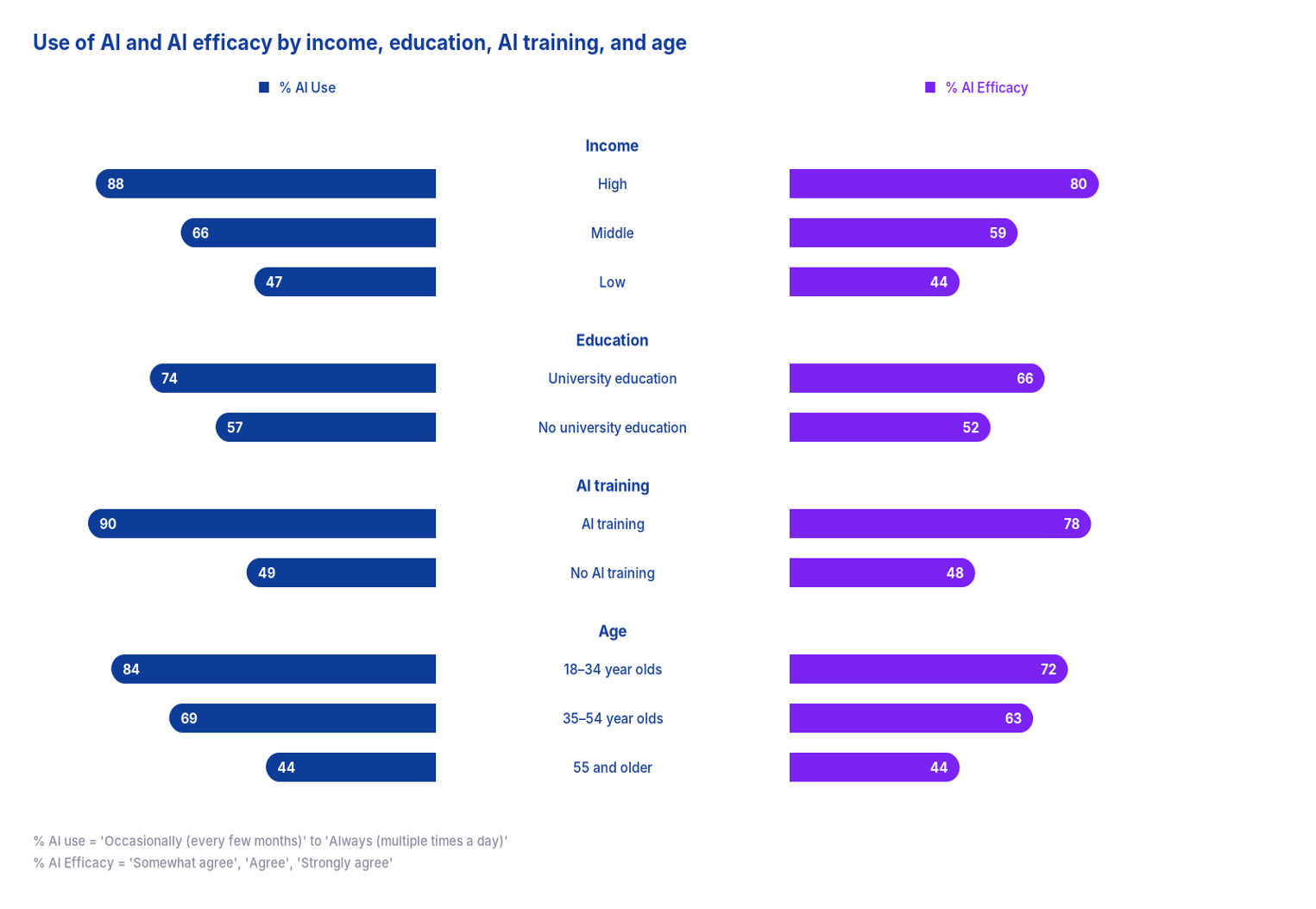
Similar to the digital divide, income and education play a role in how people and communities avail the opportunities that current and emerging AI technologies afford. This is supported by a recent study by the University of Melbourne and KPMG of over 48,000 people across 47 countries: people with higher income, university-education, and AI training – as well as younger people -are more likely to use AI and to use it skilfully (see Figure below).

Source: Gillespie, N., Lockey, S., Ward, T., Macdade, A., & Hassed, G. (2025). Trust, attitudes and use of artificial intelligence: A global study 2025. The University of Melbourne and KPMG. DOI 10.26188/28822919.
These findings replicate for AI at work: younger workers and those with higher income, university education and AI training are more likely to use AI at work. Further, higher-income and AI trained workers report more positive impacts from AI use at work. For example, high-income earners are more likely to have experienced increased quality and accuracy of work due to AI use (72%) compared to middle- (54%) and low-income employees (44%). Income is itself strongly associated with AI training: 70% of high-income earners report having completed some form of AI training compared to only 18% of low-income earners.
These findings reinforce that just as digital skills equip individuals to better use ICT tools, AI literacy enables effective use of consumer AI (e.g., GenAI tools, chatbots, recommendation engines). At the organisational level, enterprise AI relies on specialised AI talent to design, deploy, and govern systems. The difference between effective use at an individual level versus organisational level is marked by usage versus creation, and personal benefits versus strategic organisational advantage, both presenting a different set of education and governance challenges.
Similar to previous divides, AI Privilege is further sharpened by the paywall surrounding higher‑performing, more secure consumer AI models, with meaningful access increasingly reliant on the ability to pay. At the organisational level, the gap widens further as well‑resourced firms can build private, customised enterprise AI systems that protect data and embed strategic advantage. Smaller organisations are largely confined to generic tools, reinforcing asymmetries in capability and long‑term competitiveness.
At the same time, unlike earlier divides, AI privilege is shaped by additional determinants such as data ownership, access to compute and energy sources, and divergent views on trust in AI.
AI privilege emerges first through disparities in access to infrastructure. Current AI Models use a lot of computational power and consequently a lot of energy, raising barriers both in terms of capital and environmental impacts. Access to computational power and energy remains uneven, often concentrated among well‑resourced organisations and regions. This risks widening inequality as SMEs, public‑sector agencies, and under‑resourced communities struggle to participate fully in an AI‑driven economy. Meanwhile, global reliance on foreign models and infrastructure raises strategic vulnerabilities for countries like Australia, underscoring the importance of building sovereign Enterprise AI capability—an objective at the core of the Alliance’s mission to assemble and accelerate national research strength for economic and social good.
Data ownership is a central determinant of AI privilege because contemporary AI systems are fundamentally shaped by who controls, licenses, and curates data. Access to large, high‑quality datasets is increasingly confined to big tech firms, while ownership of the data remains murky. Even where data is available, the costs of acquisition, cleaning, annotation, and continuous updating are substantial, requiring time, capital, and specialised expertise. These barriers favour large technology firms and well‑resourced organisations, while smaller actors remain dependent on generic models. As a result, AI capabilities, and the economic and decision‑making power they enable, become concentrated among those who can access and sustain data at scale.
Another determinant of AI privilege is trust. Without adequate governance and capability AI projects can fail to deliver on their promises, and those that do, often operate as opaque “black boxes,” making it difficult for individuals and organisations to understand or challenge decisions. Bias, privacy concerns, and hallucinations further erode confidence, hampering adoption. Trust differences evident in age groups, income levels and educational backgrounds further widen the divide between those who can successfully use and benefit from AI, potentially deepening economic and societal inequality.
“Curtailing AI privilege requires coordinated action at multiple levels. Individuals can invest in AI literacy; institutions need to build responsible governance and workforce capability; and national agencies must invest in infrastructure, regulation, and secure and fair data access to ensure AI benefits are shared widely.
By advancing responsible, scalable, and equitable Enterprise AI, the Alliance is helping ensure Australian enterprises not just adopt AI but thrive with it.” – Professors Nicole Gillespie, Tim Miller, and Shazia Sadiq
Nicole Gillespie is the Chair in Trust & Professor of Management at Melbourne Business School at the University of Melbourne. She is an internationally recognised scholar on trust in organisations.
Tim Miller is the UQ-TIET Chair in Data Science and Professor of Artificial Intelligence at The University of Queensland. Tim’s expertise includes explainable AI, human-AI planning, & human-centred decision support.
Shazia Sadiq FTSE is a Professor of Computer Science at The University of Queensland, and Director of the Centre for Enterprise AI, Centre for Information Resilience (CIRES), and AI Research Network.


 Marek Kowalkiewicz is Professor and Chair in Digital Economy at QUT Business School, and a member of the Australian Research Alliance for Enterprise AI. His research focuses on algorithms as economic actors: how they acquire authority, reshape work, and create new governance challenges for organisations. His current work at QUT’s Centre for Future Enterprise investigates how enterprises transition from automating tasks to autonomising decisions, and the organisational implications of that shift.