If Dull, Dirty, and Dangerous isn’t the answer, what is?

Alliance member Professor Tim Miller from The University of Queensland shares this opinion piece on the importance of adopting human-centered approaches that explicitly identify areas where AI tools can add real value, not just speed up dull, dirty and boring tasks. 

“Integrating AI will help us to free ourselves from the dull, dirty, and dangerous tasks to focus on tasks that require creativity, complex problem-solving, and deeper engagement” 

Most of us will have heard of a quote like the above, on the promise of AI in the Enterprise. Let’s assume for a second that contemporary AI tools do become good enough to free us from many of our dull tasks, a question remains: will it really allow us to focus on higher-level tasks? 

I believe there are reasons to doubt that this will be the case, with the primary reason being the limits of human cognitive ability: we are just simply not wired to take advantage of this.  As Professor Gloria Mark, Professor of Informatics at University of California, Irvine writes in her book Attention span: A groundbreaking way to restore balance, happiness and productivity:  

“We can’t meet the high mental challenge of being focused for long stretches throughout the day, just as we can’t be challenged to lift weights nonstop all day, without performance starting to degrade when we run out of energy (or cognitive resources). …. 

Letting our minds wander while taking breaks with easy tasks, both online and in the physical world, helps us replenish our scarce cognitive resources, and with more resources, we are better able to focus and be productive”1

Cognitive depletion 

What Professor Mark identifies here is cognitive depletion. Performance on cognitive tasks suffers when our workload exceeds the cognitive resources that we have available, which is estimated to be just 3-4 hours per day of sustained focus. As we spend more time on highly-demanding cognitive tasks, our vigilance declines. Throughout the day, we use several things to replenish these, such as taking breaks, playing games, or, yes, even doing dull and dirty tasks, such as checking email, admin tasks, filling out reports, cleaning the coffee machine, etc. 

This indicates that, if we can semi-automate the dull tasks, we’ll have more time, but we won’t have the cognitive resources to do those higher-level tasks. 

So, what will we do with our new-found time? 

Some people, like me, might hope we would use this time for rest and relaxation, a much-needed break to offset cognitive depletion. 

Recent data from ActivTrak2 shows that we may be seeing a paradox with AI tools and knowledge workers, with two of the main findings being particularly grim: 

  1. “Among AI users, time spent across every measured work category increased between 27% and 346% — with email up 104%, chat and messaging up 145% and business management up 94%”

  2. “AI users’ daily focus time declined 9%, compared to virtually no change for non-users” 

This means people using AI for automating dull, low-value tasks just do more dull, low-value tasks, and spend less time on focused work. This is the opposite of what we want. 

How do we make sense of this? The Jevons Paradox, identified by economist Stanley Jevons in 1845, notes that, as the cost of doing some tasks decreases, the amount of resource (e.g. time) we spend increases. In the case of knowledge work, this points to a disturbing scenario: AI tools make dull tasks easier while not reducing their value to the business, so we can ‘produce more’ by doing more of these. 

If Dull, Dirty, and Boring isn’t the answer, what is? 

The failure of AI tools to save us from busywork signals a critical need to change the way we design enterprise technology. 

We need to move away from seeing AI tools just as a way to speed up dull, dirty and boring work, and pivot to a vision where AI tools improve creative, complex and cognitively-demanding work too. If we want more high-value work done, we should exploit the Jevons Paradox by making that cognitively-demanding work easier, reducing friction and slowing down mental fatigue.

“A key focus of our research in the Australian Research Alliance for Enterprise AI: adopting human-centered approaches that explicitly identify areas where AI tools can add real value, not just speed up dull, dirty and boring tasks.” – Professor Tim Miller 

References 

[1] Mark, Gloria. Attention span: A groundbreaking way to restore balance, happiness and productivity. Harlequin, 2023. 

[2] ActivTrak Productivity Lab: AI Is Accelerating Work, Not Replacing It, March 2026. https://www.activtrak.com/news/state-of-the-workplace-ai-accelerating-work/


Tim Miller is the UQ-TIET Chair in Data Science and Professor of Artificial Intelligence at The University of Queensland. His research draws on machine learning, reinforcement learning, AI planning, interaction design, and cognitive science, to help people make better decisions. Tim’s expertise includes explainable AI, human-AI planning, & human-centred decision support.

Enterprise AI: A Comprehensive Reference

About the book

Released in 2025, this book brings together leading perspectives on the barriers, opportunities, and emerging practices shaping Enterprise AI. It explores state-of-the-art approaches that enable organisations to adopt AI more effectively and at scale, while addressing the technical, organisational, and socio-technical challenges inherent in enterprise contexts.

Designed as a comprehensive and authoritative reference, the book provides students, researchers, and practitioners with a single, integrated resource that spans the full lifecycle of Enterprise AI projects—bringing together both the problems and the solutions in one place.

Edited by Professor Shazia Sadiq FTSE at The University of Queensland, the book features contributions from several members of the Australian Research Alliance for Enterprise AI, alongside leading international scholars and practitioners.

AVAILABLE FOR PURCHASE HERE


“It has been a privilege to work with international scholars and leaders to bring together this comprehensive and authoritative resource on Enterprise AI, so that students, researchers and practitioners can access the full scope of the topic in one place.” – Professor Shazia Sadiq FTSE.


Structure and Themes

Expert contributions spanning multiple socio-technical disciplines are organised into three complementary parts:

Part I: Scalable and Sustainable Practices for Enterprise AI

This section examines emerging strategies that enable organisations to scale AI systems sustainably—maximising performance while minimising resource consumption. It offers in-depth exploration of three complementary approaches that address scalability from different perspectives: data distillation, federated learning, and resource‑efficient deployment.

Part II: Safe and Responsible Enterprise AI

Focusing on the critical dimensions of AI safety in enterprise settings, this section provides a practical and principled foundation for responsible AI implementation. Across four chapters, it addresses key issues including data quality, privacy, explainability, and human–AI collaboration, laying the groundwork for AI systems that are transparent, trustworthy, and aligned with organisational and societal values.

Part III: Value Creation with Enterprise AI

The final section presents a multidimensional view of how enterprises can create value with AI—balancing innovation with responsibility, and efficiency with trust. The four chapters offer a roadmap for using AI not merely as a tool for automation, but as a catalyst for meaningful, sustainable organisational transformation.

From PoC to Production: Scaling Enterprise AI

At the Australian Research Alliance for Enterprise AI, our mission is clear: to assemble, strengthen, and accelerate Australia’s research capability in Enterprise AI, positioning the nation as a global leader in trustworthy, reliable, and high‑impact AI innovation. As AI transforms every industry, the need for research‑driven methods, transdisciplinary expertise, and responsible scaling has never been more urgent.

One of the key challenges, we are hearing from our partners across sectors, is the struggle to move from experimentation to enterprise‑wide impact. Many leaders face the same challenge: how do we scale AI and deliver meaningful ROI? While enthusiasm for pilots is high, the pathway to production is frequently undermined by fragmented data assets, mismatched expectations, and insufficient evaluation of business value. As a result, proof‑of‑concept (PoC) projects often overperform in isolation. However, they stay as PoCs leaving organisations with a PoC graveyard or they fail to translate into sustainable, integrated capabilities once deployed.

Insights from our recent Enterprise AI workshop hosted at The University of Queensland, make the gap between PoC and production abundantly clear. Participants highlighted that data quality, access, and validation remain foundational impediments bringing out the old cliche of “garbage in, garbage out” as a recurring operational reality. Trust, transparency, and governance emerged as equally critical, with organisations warning against “governance theatre” and emphasising the need for meaningful oversight and evaluation frameworks robust to changing data, personnel, and models.

As the Alliance continues its work, we remain committed to partnering with industry, government, and academia to build the research foundations, governance frameworks, and capability pipelines needed to turn promising use cases and prototypes into reliable, high‑value enterprise AI systems.


Professor Shazia Sadiq FTSE is Director of the Centre for Enterprise AI, Centre for Information Resilience (CIRES), and AI Research Network at The University of Queensland (UQ). Shazia also leads the Australian Research Alliance for Enterprise AI.


When a Bot Evaluates Work: Five Moves for Reclaiming Authority from AI

Enterprise AI systems are increasingly being given authority over human work, including evaluating performance, moderating content, flagging noncompliance, and even reversing human-made decisions. Unlike consumer AI tools that people choose to use, these systems are embedded in organisational infrastructure, and the people subject to their evaluations often have no say in whether or how the AI was deployed: a captive relationship that makes questions of trust and legitimacy unavoidable.

In a paper co-authored by Nadine Ostern, Likoebe Maruping, Enterprise AI Alliance member Marek Kowalkiewicz, Jörg Weking, and Jason Thatcher, published in MIS Quarterly (the top-ranked journal in information systems), the authors examined what happens when an organisation delegates evaluative authority to an AI. The single most important finding: the people subject to AI authority will reshape it, whether the organisation plans for that or not. Using Wikipedia’s antivandalism bot as a case, the authors traced how those subject to the bot’s evaluations progressively contested and reclaimed authority through five mechanisms. The authors term these mechanisms SAFER: Scoping, Adapting, Flagging, Escalating, and Requesting. What began as ad hoc pushback evolved into institutionalised governance structures that gave people durable influence over AI decisions.

The paper develops a grounded theory of how authority delegated to AI-based bots is dynamically redistributed through recursive negotiation between developers, the humans subject to the bot’s evaluations, and the bot itself. It identifies three phases of authority configuration: malleable adaptation, on-request intermediation, and continuous influence, showing how human agency over AI governance can be progressively institutionalised rather than eroded.

“For enterprise AI leaders, the practical lesson is direct. Delegating evaluative authority to AI is not a one-time design decision. It initiates an ongoing negotiation. Organisations that build mechanisms for contestation and adjustment into their AI systems from the start, rather than discovering the need reactively, will achieve more reliable, trusted, and legitimate AI deployments.” – Professor Marek Kowalkiewicz


Marek Kowalkiewicz is Professor and Chair in Digital Economy at QUT Business School, and a member of the Australian Research Alliance for Enterprise AI. His research focuses on algorithms as economic actors: how they acquire authority, reshape work, and create new governance challenges for organisations. His current work at QUT’s Centre for Future Enterprise investigates how enterprises transition from automating tasks to autonomising decisions, and the organisational implications of that shift.

AI Privilege

With the rapid rise of AI technologies across consumer and enterprise markets, we face a growing socio‑economic divide best described as AI privilege, where access to AI capabilities, skills, and trustworthy systems becomes unevenly distributed. In this article Alliance members, Professor Nicole Gillespie, Professor Tim Miller, and Professor Shazia Sadiq shed light on the determinants of AI Privilege and the contextual conditions that contribute to a widening of the gap.  

The digital divide emerged in the 1990s alongside the rapid diffusion of personal computing and the internet. Key determinants included income, education, geography, infrastructure access, and digital skills. Its implications were profound, reinforcing social and economic inequalities, limiting organisational competitiveness, and constraining national development by unevenly distributing access to information, services, and innovation. 

AI Privilege can be understood as the digital divide on steroids: a structural advantage held by actors with access to large datasets, advanced compute, energy sources, proprietary models, and skilled talent. Uneven AI diffusion will intensify inequalities by amplifying divides in productivity, decision power, and influence.  

Examples of AI privilege already appear in education, where students who can afford advanced AI tools receive better personalised learning support. A large enterprise may use AI to forecast demand, reduce stockouts, optimise warehousing and negotiate better supplier terms, whereas this may not be accessible to an SME with tight budgets, scarce resources and limited technical expertise.  

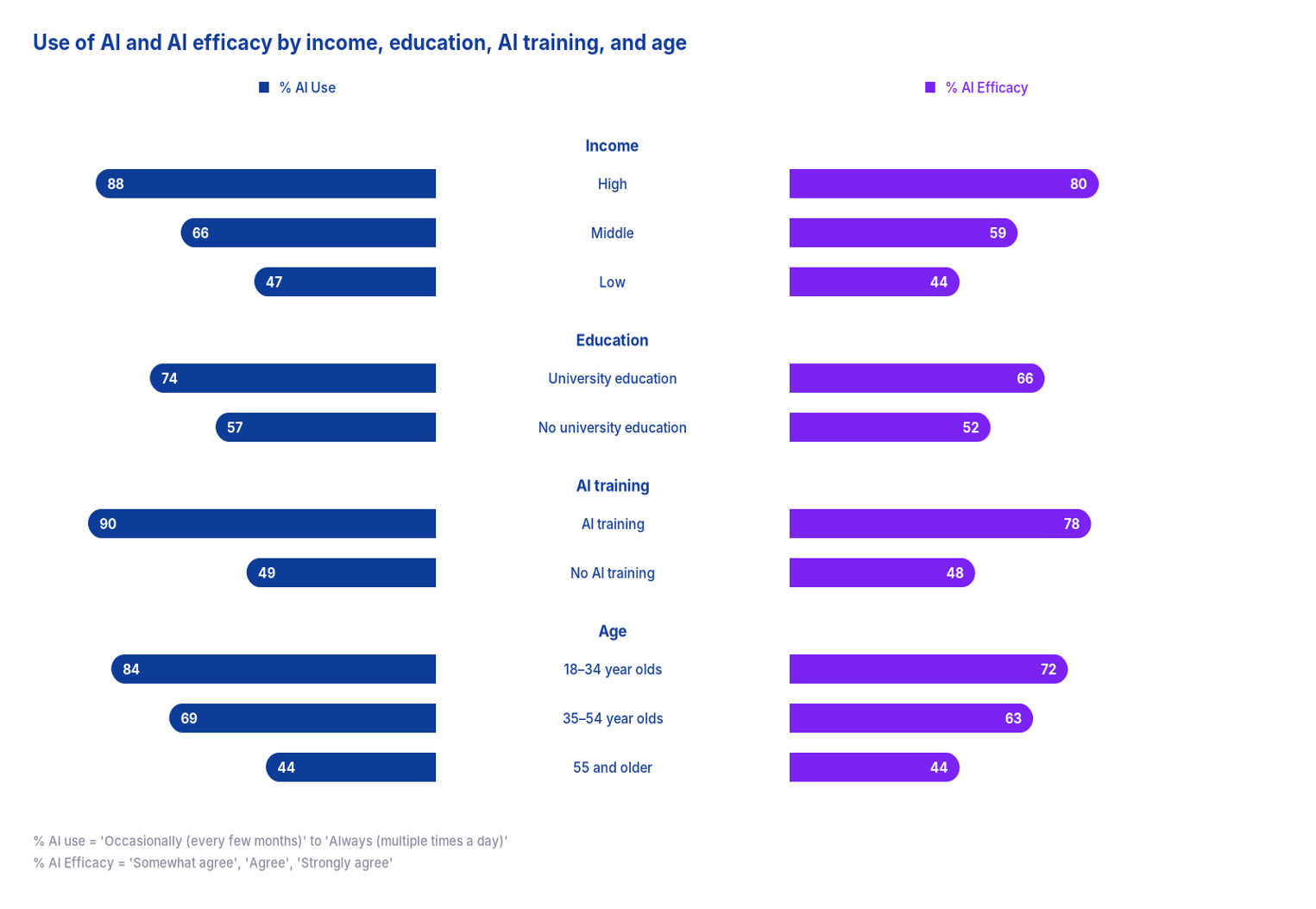
Similar to the digital divide, income and education play a role in how people and communities avail the opportunities that current and emerging AI technologies afford. This is supported by a recent study by the University of Melbourne and KPMG of over 48,000 people across 47 countries: people with higher income, university-education, and AI training – as well as younger people -are more likely to use AI and to use it skilfully (see Figure below).  


Source: Gillespie, N., Lockey, S., Ward, T., Macdade, A., & Hassed, G. (2025). Trust, attitudes and use of artificial intelligence: A global study 2025. The University of Melbourne and KPMG. DOI 10.26188/28822919. 

These findings replicate for AI at work: younger workers and those with higher income, university education and AI training are more likely to use AI at work. Further, higher-income and AI trained workers report more positive impacts from AI use at work. For example, high-income earners are more likely to have experienced increased quality and accuracy of work due to AI use (72%) compared to middle- (54%) and low-income employees (44%). Income is itself strongly associated with AI training: 70% of high-income earners report having completed some form of AI training compared to only 18% of low-income earners. 

These findings reinforce that just as digital skills equip individuals to better use ICT tools, AI literacy enables effective use of consumer AI (e.g., GenAI tools, chatbots, recommendation engines). At the organisational level, enterprise AI relies on specialised AI talent to design, deploy, and govern systems. The difference between effective use at an individual level versus organisational level is marked by usage versus creation, and personal benefits versus strategic organisational advantage, both presenting a different set of education and governance challenges.  

Similar to previous divides, AI Privilege is further sharpened by the paywall surrounding higherperforming, more secure consumer AI models, with meaningful access increasingly reliant on the ability to pay. At the organisational level, the gap widens further as wellresourced firms can build private, customised enterprise AI systems that protect data and embed strategic advantage. Smaller organisations are largely confined to generic tools, reinforcing asymmetries in capability and longterm competitiveness. 

At the same time, unlike earlier divides, AI privilege is shaped by additional determinants such as data ownership, access to compute and energy sources, and divergent views on trust in AI. 

AI privilege emerges first through disparities in access to infrastructure. Current AI Models use a lot of computational power and consequently a lot of energy, raising barriers both in terms of capital and environmental impacts. Access to computational power and energy remains uneven, often concentrated among well‑resourced organisations and regions. This risks widening inequality as SMEs, public‑sector agencies, and under‑resourced communities struggle to participate fully in an AI‑driven economy. Meanwhile, global reliance on foreign models and infrastructure raises strategic vulnerabilities for countries like Australia, underscoring the importance of building sovereign Enterprise AI capability—an objective at the core of the Alliance’s mission to assemble and accelerate national research strength for economic and social good.  

Data ownership is a central determinant of AI privilege because contemporary AI systems are fundamentally shaped by who controls, licenses, and curates data. Access to large, highquality datasets is increasingly confined to big tech firms, while ownership of the data remains murky. Even where data is available, the costs of acquisition, cleaning, annotation, and continuous updating are substantial, requiring time, capital, and specialised expertise. These barriers favour large technology firms and wellresourced organisations, while smaller actors remain dependent on generic models. As a result, AI capabilities, and the economic and decisionmaking power they enable, become concentrated among those who can access and sustain data at scale. 

Another determinant of AI privilege is trust. Without adequate governance and capability AI projects can fail to deliver on their promises, and those that do, often operate as opaque “black boxes,” making it difficult for individuals and organisations to understand or challenge decisions. Bias, privacy concerns, and hallucinations further erode confidence, hampering adoption. Trust differences evident in age groups, income levels and educational backgrounds further widen the divide between those who can successfully use and benefit from AI, potentially deepening economic and societal inequality. 

“Curtailing AI privilege requires coordinated action at multiple levels. Individuals can invest in AI literacy; institutions need to build responsible governance and workforce capability; and national agencies must invest in infrastructure, regulation, and secure and fair data access to ensure AI benefits are shared widely. 

By advancing responsible, scalable, and equitable Enterprise AI, the Alliance is helping ensure Australian enterprises not just adopt AI but thrive with it.” – Professors Nicole Gillespie, Tim Miller, and Shazia Sadiq


Nicole Gillespie is the Chair in Trust & Professor of Management at Melbourne Business School at the University of Melbourne. She is an internationally recognised scholar on trust in organisations.


Tim Miller is the UQ-TIET Chair in Data Science and Professor of Artificial Intelligence at The University of Queensland. Tim’s expertise includes explainable AI, human-AI planning, & human-centred decision support.



Shazia Sadiq FTSE is a Professor of Computer Science at The University of Queensland, and Director of the Centre for Enterprise AI, Centre for Information Resilience (CIRES), and AI Research Network.